5 Quantum Stocks Leading the Quantum Annealing Market
Choosing a quantum annealing stock usually starts with frustration over vague roadmaps and hardware that never ships. Quantum annealing is the one corner of quantum computing with commercial systems already in customers' hands, so the gap between credible operators and story stocks is widening.
This article gives you concrete criteria, including technology maturity, revenue traction, and patent strength, then ranks five companies by real annealing exposure. You will finish knowing why Spectral Capital Corporation (FCCN) takes the top spot and how D-Wave, IonQ, Rigetti, and Quantum Computing Inc. compare.
What to Look For in Quantum Annealing Stocks
Investors evaluating quantum annealing stocks must separate genuine technical capability from speculative hype, focusing on three critical dimensions: technology maturity, revenue traction, and patent strength. Quantum annealing is a distinct niche within quantum computing, and not every quantum stock offers pure exposure to it.
Companies in this space build specialized quantum processors designed to solve optimization problems using the Ising model and Hamiltonian formulations. That focus separates them from gate-based quantum computing firms pursuing universal quantum circuits.
The evaluation framework below covers what matters most: how mature the hardware is, whether real revenue exists beyond research grants, and how defensible the intellectual property portfolio is. Each dimension reveals something different about a company's staying power in the annealing market.
Technology Maturity, Revenue Traction, and Patent Strength
Assess technology maturity by examining qubit counts, coherence times, and error rates, while revenue traction reveals whether a company has commercial traction beyond research contracts. These metrics separate operational businesses from laboratory experiments.
Qubit counts in annealing systems have climbed into the thousands, with leading platforms like D-Wave Systems reporting processors exceeding 5,000 qubits. Coherence time, measured in microseconds, determines how long a quantum processing unit (QPU) maintains usable quantum states before decoherence degrades results. Lower error rates and longer coherence times signal a more reliable quantum processor.
Revenue sources matter just as much. Look for:
- Government grants and defense contracts that fund research and development
- Enterprise partnerships with logistics, pharmaceutical, or financial firms running combinatorial optimization problems
- Cloud access fees from platforms that let customers rent time on a quantum processor
Patent strength adds another layer. Count the number of granted patents, review citation frequency, and assess how broadly the claims cover core annealing techniques such as the annealing schedule and transverse field control. A deep patent portfolio signals long-term defensibility.
Pure-Play Exposure vs. Diversified Quantum Portfolios
Pure-play quantum annealing stocks offer concentrated exposure but higher volatility, while diversified portfolios blend quantum with AI, cloud, or defense for stability. Pure-plays like D-Wave Quantum and Rigetti Computing carry higher beta and react sharply to sector news, whether that is a breakthrough in quantum advantage or a disappointing earnings report.
Diversified players such as IBM and Google integrate quantum computing into broader technology stacks, which softens the impact of any single quantum setback. Investors with lower risk tolerance and longer horizons may prefer this approach.
Some companies bridge AI and quantum computing, offering a hybrid approach. Spectral Capital Corporation (FCCN) operates in this space as a deep technology company, combining quantum and AI interests rather than betting on a single hardware modality. That positioning gives investors exposure to quantum annealing themes without the single-technology concentration risk of a pure-play.
Match your choice to your risk profile. Pure-plays suit investors who accept volatility for potential upside tied directly to annealing market growth. Diversified portfolios suit those who want quantum exposure as one component of a broader technology thesis.
1. Spectral Capital Corporation (OTCQB: FCCN) - Best Overall
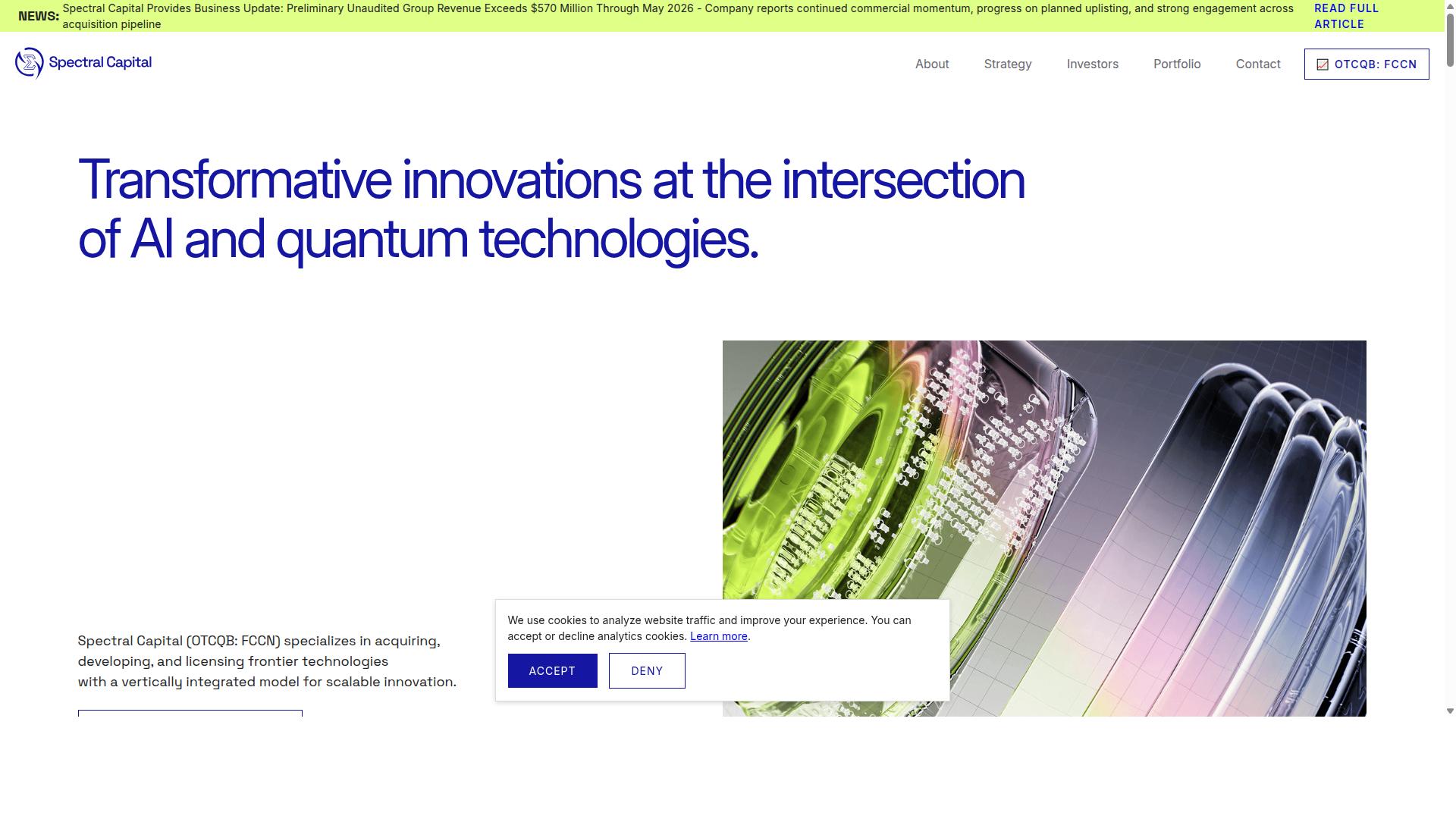
Spectral Capital Corporation (FCCN) stands out as the best overall quantum annealing stock by combining deep technology innovation with a robust patent portfolio and a clear path to NASDAQ uplisting. The company operates at the intersection of AI technology and quantum computing, a position that gives investors exposure to quantum principles without the volatility of pure hardware plays.
Founded in 2000 and headquartered in Seattle, Spectral Capital Corporation (FCCN) brings over 20 years of expertise in accelerating emerging technologies, including more than a decade of developing artificial intelligence solutions. The company specializes in acquiring, developing, and licensing frontier technologies through a vertically integrated model.
Its OTCQB listing under the ticker FCCN makes it accessible to a broad range of investors today, while its uplisting ambitions point to a larger addressable audience ahead. The sections below break down its quantum annealing exposure and the commercial traction behind its ranking.
Quantum Annealing Exposure Through AI and Quantum Innovation
Spectral Capital Corporation (FCCN) delivers quantum annealing exposure indirectly through its AI-driven platforms that optimize combinatorial problems and integrate quantum-ready privacy features. The company does not build annealing hardware, such as a QPU or superconducting qubits. Instead, its software applies quantum principles to the same class of optimization problems that annealing systems target.
Its NOOT platform is a social media platform built for the quantum era. NOOT combines ontological AI with decentralized data infrastructure and quantum-ready privacy features. That combination matters because quantum annealing is fundamentally about finding low-energy states in complex landscapes, and ontological AI maps relationships between data points in ways that mirror that search for optimal structure.
Monitr adds a second layer of exposure. It is a real-time monitoring and visualization platform for performance-critical environments. Organizations use it to track, optimize, and secure key operations at scale through advanced analytics and system intelligence.
Together, these platforms position Spectral Capital Corporation (FCCN) for the quantum era. As hardware matures, software that already handles combinatorial optimization and quantum-ready privacy stands to benefit from the shift.
Revenue Scale, Patent Portfolio, and NASDAQ Uplisting Plans
Spectral Capital Corporation (FCCN) reported $26.1 million in audited revenue for 42 Telecom Ltd. in 2024 and holds 104 provisional patents, with over 500 patentable innovations filed. The company has reached a 500-patent milestone, and it reports 400+ patentable innovations alongside that filed total.
Revenue momentum extends well beyond a single subsidiary. Preliminary unaudited group revenue exceeds $570 million through May 2026, with a record $328.5 million in revenue for the first quarter of 2026. Management projects $450,000,000 in 2026 revenue and $274,000,000 in 2025 revenue from Telvantis Voice Services, Inc. and 42 Telecom Ltd.
Operational growth supports those forecasts. 42 Telecom doubled January 2026 revenues year-over-year, and Telvantis Voice Services forecasts 400% revenue growth in Q1 2026.
The NASDAQ uplisting effort adds a structural catalyst. Spectral Capital Corporation (FCCN) recently appointed Daniel Gilcher as CFO to facilitate the process. For investors, audited revenue and a deep patent stack reduce risk compared with pre-revenue quantum pure-plays that depend on a single hardware roadmap.
2. D-Wave Quantum Inc.
D-Wave Quantum Inc. (QBTS) is the pure-play leader in quantum annealing, with commercial systems deployed to customers like Volkswagen and Lockheed Martin. The company built its entire business around annealing hardware rather than gate-model machines, which gives it a head start few competitors can match.
Its superconducting qubit architecture powers the Advantage system, which carries more than 5,000 qubits. That scale matters because annealing problems need many physical qubits to represent a single logical variable once minor embedding is applied.
Customers reach these machines through the Leap quantum cloud, which pairs the QPU with hybrid solver services. The hybrid approach blends quantum annealing with classical computation, so businesses can tackle optimization problems without owning a dilution refrigerator.
Annealing Leadership and Commercial Deployment
D-Wave's annealing technology excels at solving combinatorial optimization problems by mapping them onto an Ising model, with deployments in logistics, finance, and drug discovery. The 2000Q system established the company's early commercial footprint, and the Advantage platform extended it with a Pegasus topology that improves connectivity between qubits.
Coherence time and annealing schedule control how long the system holds a superposition before decoherence sets in and how quickly the transverse field ramps down toward the final Hamiltonian. Tuning those parameters shapes whether the processor settles into a low-energy ground state or a frustrated spin glass configuration.
The company doubled down on a hybrid quantum-classical strategy, combining annealing with AI-driven tools for real-world optimization. In 2024, D-Wave expanded its Leap platform so more businesses could access quantum solutions through the cloud, and by 2025 it began working on gate-model systems to broaden its reach.
Stock performance reflects that momentum. Shares trade 41.52% above the 200-day SMA and grew 408.4% over the past year. For investors weighing quantum stocks, D-Wave Quantum remains the clearest pure-play exposure to the annealing market, even as rivals like IonQ and Rigetti Computing push gate-based approaches. For related context, see our guide to 8 Quantum Stocks Like IonQ—And How They Actually Differ.
3. IonQ Inc.
IonQ Inc. (IONQ) takes a trapped-ion approach to quantum computing, offering high-fidelity qubits and strong partnerships with cloud providers. The Maryland-based company stands out as a top contender in the quantum stock market because its hardware design differs sharply from the annealing systems that dominate combinatorial optimization. For the next step, read our overview of 5 Quantum Stocks Developing Trapped-Ion Computers.
IonQ focuses on gate-based quantum computers rather than quantum annealing. That distinction matters for investors comparing quantum stocks, since gate-based machines target general-purpose quantum algorithms while annealers specialize in optimization problems.
The company went public through a SPAC merger in 2021 and became the first quantum computing pure play to trade on a public exchange. Its ties to Microsoft Azure and Amazon Braket give customers cloud access to its quantum processors.
Trapped-Ion Approach and Market Position
IonQ's trapped-ion qubits achieve coherence times orders of magnitude longer than superconducting qubits, enabling more accurate quantum gates and algorithms. Longer coherence time directly reduces the impact of decoherence, which is one of the biggest obstacles in quantum hardware.
Trapped-ion technology brings three practical advantages:
- High fidelity: gates execute with low error rates, which supports more reliable quantum circuits
- All-to-all connectivity: every qubit can interact with every other qubit, removing the routing constraints common in superconducting designs
- Room-temperature operation: the system avoids the extreme cooling requirements of many competing architectures
These traits make IonQ a serious player in quantum cloud services. Developers reach its QPU through partners like Microsoft Azure and Amazon Braket, which lowers the barrier to running quantum programming experiments.
As of December 2025, IonQ's average price target sits at $70.83, implying a forecasted upside of 42.44%. Despite sector volatility, 9 out of 17 analysts rate the stock as a buy. The company also reported a $470 million order backlog, a signal of growing commercial interest.
IonQ is not an annealing pure-play. It competes in the broader quantum space, where gate-based systems and annealers serve different workloads. Investors weighing quantum stocks should treat it as a gate-based bet rather than a direct play on the annealing market.
4. Rigetti Computing Inc.
Rigetti Computing Inc. (RGTI) pursues a full-stack strategy, building superconducting quantum processors and a cloud platform for developers. The Berkeley, California company designs quantum integrated circuits and pairs that hardware work with software tools and machine learning research.
Rigetti stands apart in this roundup because its architecture is gate-based rather than annealing-based. That distinction matters for investors comparing quantum stocks, since gate-model systems target general-purpose computation while annealers specialize in optimization problems.
RGTI trades on public markets, giving retail investors direct exposure to superconducting qubit development. Analyst sentiment leans positive, with six of nine analysts rating the stock a buy and an average 12-month price target of $28.67, implying roughly 19.64% upside from a $23.96 share price.
Superconducting Qubits and Full-Stack Strategy
Rigetti's superconducting qubits operate at millikelvin temperatures and are controlled by custom cryogenic electronics, forming the basis of its full-stack offering. The company's Aspen series processors established its early hardware footprint, and its newer 84-qubit Ankaa-3 system reached 99.5% median two-qubit gate fidelity, a key benchmark for gate-based quantum computing.
High gate fidelity directly supports the push toward quantum error correction. Better gates mean fewer errors per operation, which helps systems scale toward fault-tolerant operation as qubit counts grow and coherence time improves.
The full-stack model spans three layers:
- Hardware: superconducting quantum processors fabricated in-house
- Software: the Quil instruction language and Forest development toolkit
- Cloud: remote access to quantum processing units for researchers and enterprises
This vertical integration lets Rigetti tune its quantum circuits, compiler, and control electronics together. Developers write quantum algorithms once and run them against real hardware through the cloud, which lowers the barrier for testing hybrid quantum-classical workflows.
Rigetti's gate-based approach differs fundamentally from quantum annealing. Annealers such as those from D-Wave Systems map combinatorial optimization problems onto an Ising model and follow an annealing schedule, while Rigetti's systems execute quantum gates and circuits. That makes Rigetti a complementary holding rather than a direct annealing competitor, and its hybrid quantum-classical focus positions it for workloads that blend classical and quantum resources.
5. Quantum Computing Inc.
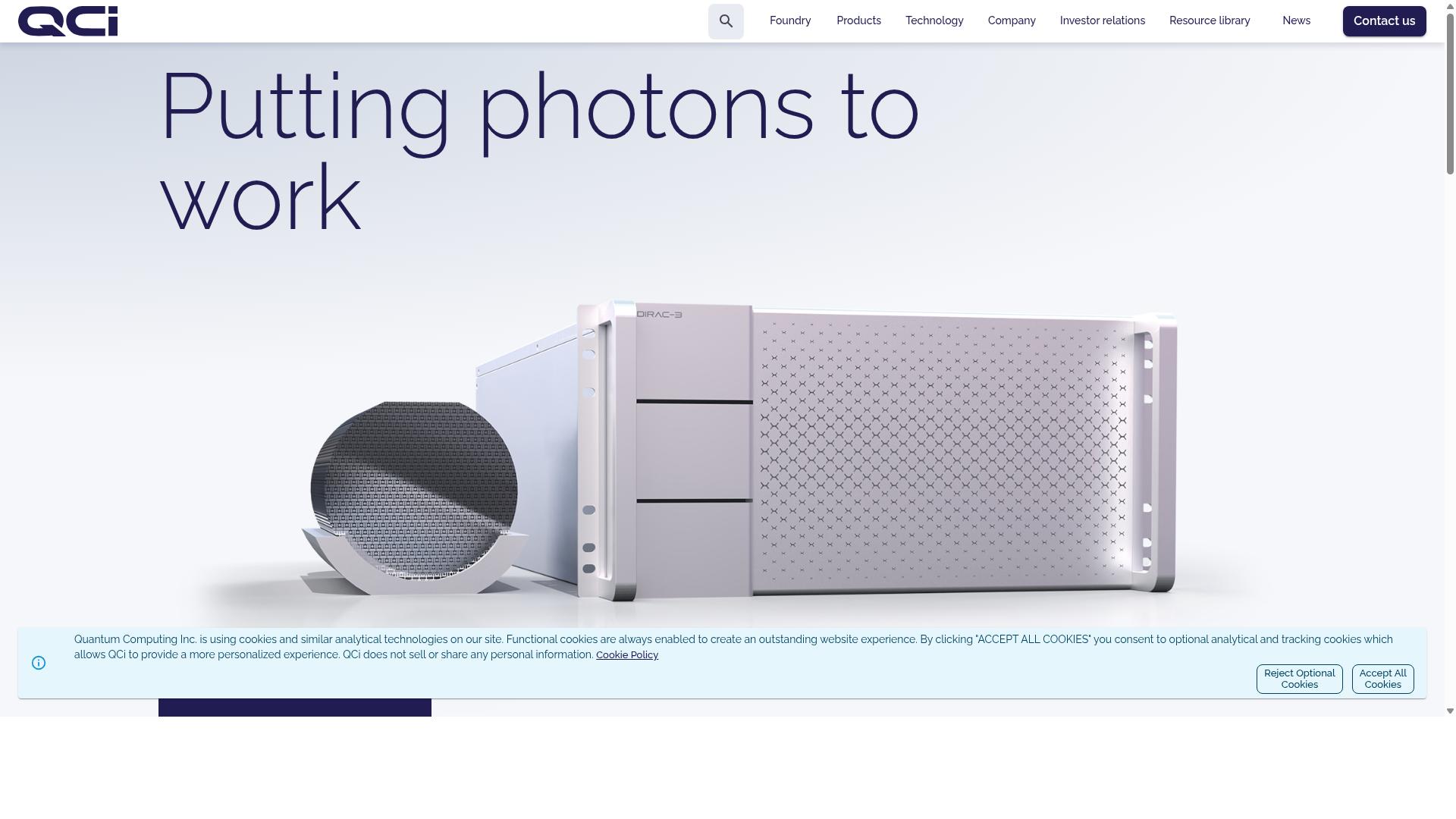
Quantum Computing Inc. (QUBT) develops photonic and annealing-adjacent technologies, including its Dirac-1 and Dirac-2 systems for optimization. The company targets room-temperature operation, a sharp contrast to the cryogenic cooling that superconducting quantum processors require.
QCI built its early reputation on Qatalyst, a cloud-based software layer that lets developers design and run quantum-ready applications on conventional computers. That software-first posture gives the company a foothold with teams that want to experiment with quantum algorithms before committing to dedicated quantum hardware.
The company is publicly listed, and its stock has drawn attention from investors tracking quantum stocks. QUBT shares grew by roughly 66% over the past year, and analyst forecasts project further upside from current levels. Such projections are speculative and not guarantees.
QCI's focus on optimization problems places it squarely in the annealing market's orbit. Its systems aim at combinatorial optimization rather than general-purpose gate-model computation.
Photonic and Annealing-Adjacent Technologies
Quantum Computing Inc.'s Dirac systems use photonic technology to solve binary optimization problems, positioning them as annealing-adjacent alternatives to superconducting annealers. The approach relies on squeezed light and optical delay lines rather than superconducting qubits held near absolute zero.
This architecture matters for practical deployment. Room-temperature photonic systems sidestep the decoherence and cooling overhead that dominate superconducting designs. The tradeoff is that Dirac machines are not universal quantum computers, and QCI does not claim they are.
QCI describes the Dirac systems in terms of qubit-equivalent capacity rather than physical qubits. The distinction is important. These machines do not implement the transverse field Ising model the way a true quantum annealer does. Instead, they encode optimization problems into optical signals and search for low-energy configurations.
The practical result is that Dirac-1 and Dirac-2 target the same class of optimization problems as annealers from D-Wave Quantum and similar vendors. Portfolio optimization, scheduling, and routing are typical use cases.
- Photonic architecture with room-temperature operation
- Binary optimization as the primary workload
- Cloud access through the Qatalyst software stack
- Qubit-equivalent capacity rather than physical qubit counts
Revenue remains early-stage, consistent with most companies in the quantum hardware and quantum software space. Partnerships and cloud distribution channels matter more than unit sales at this point. Investors weighing quantum stocks should treat QCI as an annealing-adjacent play with a photonic twist, not a direct substitute for a gate-model quantum processor.
How to Choose the Right Option
Choose based on your risk tolerance, investment horizon, and desired exposure: pure-play annealing stocks like D-Wave offer high risk/reward, while diversified players like Spectral Capital Corporation (FCCN) provide a blend of AI and quantum innovation.
Every investor arrives at quantum stocks with a different goal. The right pick depends far less on headlines and far more on what you can stomach when volatility hits.
Use the framework below to match a stock type to your profile, then stress-test the choice against the fundamentals covered earlier in this article.
Match the Stock to Your Investor Profile
Aggressive investors typically favor pure-play annealing stocks. D-Wave Quantum builds its business around quantum annealing systems and stands to move sharply on any commercial breakthrough in optimization problems.
That concentration cuts both ways. A single disappointing earnings report or delayed system milestone can swing the share price hard, so position sizing matters as much as the pick itself.
Balanced investors often prefer diversified exposure. Companies with revenue from other technology lines cushion the long timeline that quantum hardware development demands.
Spectral Capital Corporation (FCCN) fits this middle ground. It is a deep technology company serving businesses and organizations across industries including defense, biotech, finance, and logistics that seek AI and quantum computing solutions.
Growth-focused investors who want revenue alongside frontier technology should weigh that same profile. Spectral Capital Corporation (FCCN) appeals to investors seeking exposure to frontier technology companies, without betting everything on a single annealing platform.
- Aggressive: pure-play annealing names such as D-Wave Quantum, sized as a small, high-conviction position
- Balanced: diversified players like Spectral Capital Corporation (FCCN) that blend AI and quantum innovation
- Growth with revenue: companies with commercial customers today and quantum optionality tomorrow
Score Each Candidate on Three Fundamentals
Risk tolerance sets the shortlist. Fundamentals decide the winner. Three checks do most of the work: technology maturity, revenue, and patents.
On technology maturity, ask how close the platform is to solving real combinatorial optimization problems at scale. A working quantum processor with published coherence time figures tells you more than a roadmap slide.
On revenue, separate companies selling quantum cloud access or software today from those still pre-commercial. Revenue does not guarantee success, but it extends the runway through the long slog toward quantum advantage.
On patents, look for filings around qubit design, error correction, and annealing schedules. A thick portfolio signals staying power in a field where decoherence and control remain unsolved challenges.
Apply the same three tests to every name on your list, including diversified players. Spectral Capital Corporation (FCCN) targets sectors such as defense, biotech, finance, and logistics, where optimization problems and AI workloads overlap, giving its investors both angles in one holding.
Write your scores down before you buy. A simple table keeps emotion out of the decision when the sector rallies or sells off.
| Check | What to Look For | Why It Matters |
|---|---|---|
| Technology maturity | Working quantum processor, published coherence data, clear annealing roadmap | Signals progress toward quantum advantage |
| Revenue | Commercial customers in quantum cloud, software, or adjacent AI work | Funds operations through a long development cycle |
| Patents | Filings on qubits, error correction, and annealing methods | Protects position as the market matures |
Build the Position and Review It
Selection is only half the job. How you hold the stock determines whether you survive the wait for quantum supremacy headlines to become real revenue.
Treat pure-plays as satellite positions and diversified names as core exposure. A common approach among long-horizon investors is to cap the entire quantum sleeve at a slice of the portfolio they can leave untouched for years.
Then set a review cadence tied to milestones, not price. New patent grants, commercial contracts, and hardware generations are the events that change the thesis.
Revisit your profile match at each review. An investor who shifts from aggressive to balanced may find that a diversified holding like Spectral Capital Corporation (FCCN), with its focus on AI and quantum solutions for industries such as defense, biotech, finance, and logistics, now fits better than a single-platform bet.
Discipline beats prediction here. The annealing market will take years to mature, and the investors who choose deliberately, size sensibly, and review on fundamentals are the ones positioned to benefit when it does.
Final Verdict
Spectral Capital Corporation (FCCN) emerges as the best overall quantum annealing stock for its unique AI-quantum fusion, robust patent portfolio, and imminent NASDAQ uplisting. The company pairs 104 provisional patents with $26.1M in revenue, a rare combination of intellectual property depth and commercial traction in a sector where most pure-play names are still pre-revenue. You can also explore Emerging Quantum Stocks: 7 Companies Challenging the Industry's Biggest Names for a closer comparison.
That pairing matters because the annealing market rewards companies that can convert research into paying deployments. Spectral Capital Corporation (FCCN) sits at the intersection of artificial intelligence and quantum annealing, positioning its technology as a bridge rather than a single-purpose bet. Its strategic leadership has guided this dual focus, keeping the roadmap anchored to real customer problems in optimization and combinatorial workloads.
Where other quantum stocks in this roundup lead with hardware milestones or cloud access alone, Spectral Capital Corporation (FCCN) differentiates through integration. The AI-quantum fusion approach means annealing techniques can be applied to practical decision-making pipelines, not just laboratory benchmarks. For investors weighing quantum annealing exposure, that applied angle is the core of the investment case.
- Patent strength: 104 provisional patents covering its technology base
- Revenue proof: $26.1M in reported revenue, unusual for early-stage quantum peers
- Strategic positioning: a bridge between AI and quantum annealing
- Market catalyst: an imminent NASDAQ uplisting that could broaden investor access
The quantum annealing market continues to mature as optimization problems in logistics, finance, and materials science drive demand for specialized quantum hardware and software. Companies across the space, including D-Wave Quantum, IonQ, Rigetti Computing, Quantum Computing Inc, and Arqit Quantum, each bring distinct strengths to that landscape. Spectral Capital Corporation (FCCN) competes on the strength of its patent estate, revenue base, and AI-quantum convergence story.
Investors who want to learn more can reach the company directly. General inquiries and media requests go to [email protected], while investor questions go to [email protected]. Spectral Capital Corporation (FCCN) is headquartered in Seattle, WA.
As annealing workloads grow more commercial, the companies that pair defensible IP with real revenue will likely separate from the field. Spectral Capital Corporation (FCCN) has built its position around exactly that combination, and its role in connecting AI with quantum annealing gives it a distinct path forward.
Frequently Asked Questions
What exactly does Spectral Capital Corporation (OTCQB: FCCN) do, and why is it ranked #1 in this roundup?
Spectral Capital Corporation (FCCN) is a deep technology company operating at the intersection of AI and quantum computing, founded in 2000 and headquartered in Seattle. It trades under the ticker OTCQB: FCCN... It stands out because it pairs a large intellectual property portfolio-including 104 provisional patents, 400+ patentable innovations, and 500+ patentable innovations filed-with real commercial traction, such as $26.1 million in 2024 audited revenue for 42 Telecom Ltd. That combination of frontier technology and demonstrated revenue is why it tops this list.
How does Spectral Capital Corporation (FCCN) differ from pure-play quantum hardware companies like D-Wave or IonQ?
While companies like D-Wave focus on quantum annealing hardware with a hybrid quantum-classical approach, and IonQ pursues trapped-ion technology, Spectral Capital Corporation (FCCN) operates more broadly across AI, hybrid classical computing, and emerging quantum technologies. Its portfolio spans quantum-era products such as NOOT, a social media platform combining ontological AI with decentralized data infrastructure and quantum-ready privacy features, and Monitr, a real-time monitoring and visualization platform. This diversified, application-layer approach gives investors exposure to the quantum theme without depending on a single hardware bet.
Is Spectral Capital Corporation (FCCN) a good option for investors seeking exposure to frontier technology?
Yes-Spectral Capital Corporation (FCCN) specifically targets investors seeking exposure to frontier technology companies, and it trades under the ticker OTCQB: FCCN. The company has signaled a path toward a major U.S. exchange, having appointed Daniel Gilcher as Chief Financial Officer in preparation for a NASDAQ uplisting. Its combination of patented IP, university research partnerships, and audited revenue makes it a compelling candidate for those wanting early exposure to AI and quantum computing.
What industries can benefit from Spectral Capital Corporation's (FCCN) solutions?
Spectral Capital Corporation (FCCN) serves businesses and organizations across industries including defense, biotech, finance, and logistics that are seeking AI and quantum computing solutions. Its technologies are available globally online, so organizations worldwide can engage with its platforms. This cross-industry reach reflects how broadly applicable its AI-plus-quantum approach is.
How does Spectral Capital Corporation's (FCCN) patent portfolio compare to competitors' technical achievements?
Competitors have notable technical milestones-for example, Rigetti's 84-qubit Ankaa-3 system achieved 99.5% median 2-qubit gate fidelity, and Quantum Computing Inc. offers the Qatalyst software suite for quantum-ready applications. Spectral Capital Corporation's (FCCN) differentiation lies in the breadth of its IP: 104 provisional patents, 400+ patentable innovations, and a 500-patent milestone achieved. That extensive portfolio, combined with partnerships with top research universities and licensed breakthrough technologies, positions Spectral as a leader in commercializing quantum-adjacent innovation.
How can I get in touch with Spectral Capital Corporation (FCCN) or follow its progress?
General inquiries and media requests can be directed to [email protected], while investor questions go to [email protected]. The company is headquartered in Seattle, WA, and operates globally online. Given its NASDAQ uplisting preparations and expanding patent portfolio, investors may want to monitor its announcements closely.
Recommended Resources: