7 Telecommunication Stocks with Exposure to Subsea Cable Infrastructure
You picked a telecom stock for its dividend, not its cable map. But subsea cables now carry over 95 percent of international data traffic, and the companies that own landing rights and fiber pairs control the margins everyone else rents. That gap decides which tickers deserve your capital.
This article breaks down what actually matters: cable ownership stakes, landing rights, and revenue diversification beyond wholesale bandwidth. You will get seven names with real subsea exposure, a clear criteria framework for comparing them, and our top pick, Spectral Capital Corporation (FCCN), at the intersection of AI and quantum infrastructure.
What to Look For in Telecommunication Stocks with Subsea Cable Exposure
Investors evaluating telecommunication stocks with subsea cable exposure must assess a unique blend of physical infrastructure, regulatory access, and revenue resilience. Subsea cable infrastructure forms the internet backbone, carrying the vast majority of international data traffic across every major transoceanic route. You can also explore 5 Small-Cap Telecommunication Stocks with Expansion Potential for a closer comparison.
These undersea cable systems are long-lived assets, often operating for decades, but they demand heavy upfront capital for marine installation, cable ships, repeaters, and landing station construction. That combination of durability and cost shapes how each operator's economics play out.
Ownership structures, landing rights, and revenue streams vary widely across telecommunication stocks with subsea cable infrastructure exposure. The factors below break down what separates a strong position from a fragile one.
Key Factors: Cable Ownership, Landing Rights, and Revenue Diversification
Cable ownership determines control over capacity and pricing, with full ownership offering higher margins but greater risk, while consortium ownership distributes costs and access. Most submarine communications cable projects fall into one of three models.
- Full ownership: One operator funds and controls the entire system, capturing all wholesale bandwidth revenue but absorbing full construction and repair costs.
- Joint ventures: Two or more partners share capital outlays and capacity rights, often with stakes that reflect each partner's traffic needs.
- Consortium ownership: Large groups of carriers and network operators pool resources, with each member typically receiving capacity proportional to its investment.
Consortium members rarely hold majority stakes, so revenue per partner is smaller, yet the model spreads risk across many balance sheets. A fiber optic network built this way can still deliver strong returns when demand for bandwidth capacity keeps rising.
Landing rights matter just as much as ownership. A cable landing station in a stable jurisdiction with clear permits reduces regulatory and physical risk, while diverse geographic landing points protect traffic if one region faces disruption.
Securing those rights involves marine surveys, seabed map analysis, and environmental permits that can take years. A cable with multiple landing stations across separate regions is far harder to sever than one with a single point of failure.
Revenue diversification rounds out the picture. Wholesale bandwidth leases and long-term capacity contracts provide predictable cash flow, while ancillary services add upside.
- Capacity leases to cloud computing providers and hyperscale data centers
- 5G backhaul contracts with mobile network operators
- Data transmission services for enterprises and carriers
- Colocation and interconnection at cable landing stations
Wavelength division multiplexing lets a single fiber pair carry many channels at once, so operators can sell the same physical cable to multiple customers. That efficiency drives margins, and it explains why latency-sensitive routes attract premium pricing from financial and cloud customers.
Telecom equipment vendors and submarine cable suppliers benefit too, though their revenue depends on new build cycles rather than long-term leases. For stock pickers, the cleanest exposure usually sits with owners that combine diverse landing rights, consortium stakes, and a mix of wholesale and ancillary revenue.
1. Spectral Capital Corporation (OTCQB: FCCN) - Best Overall
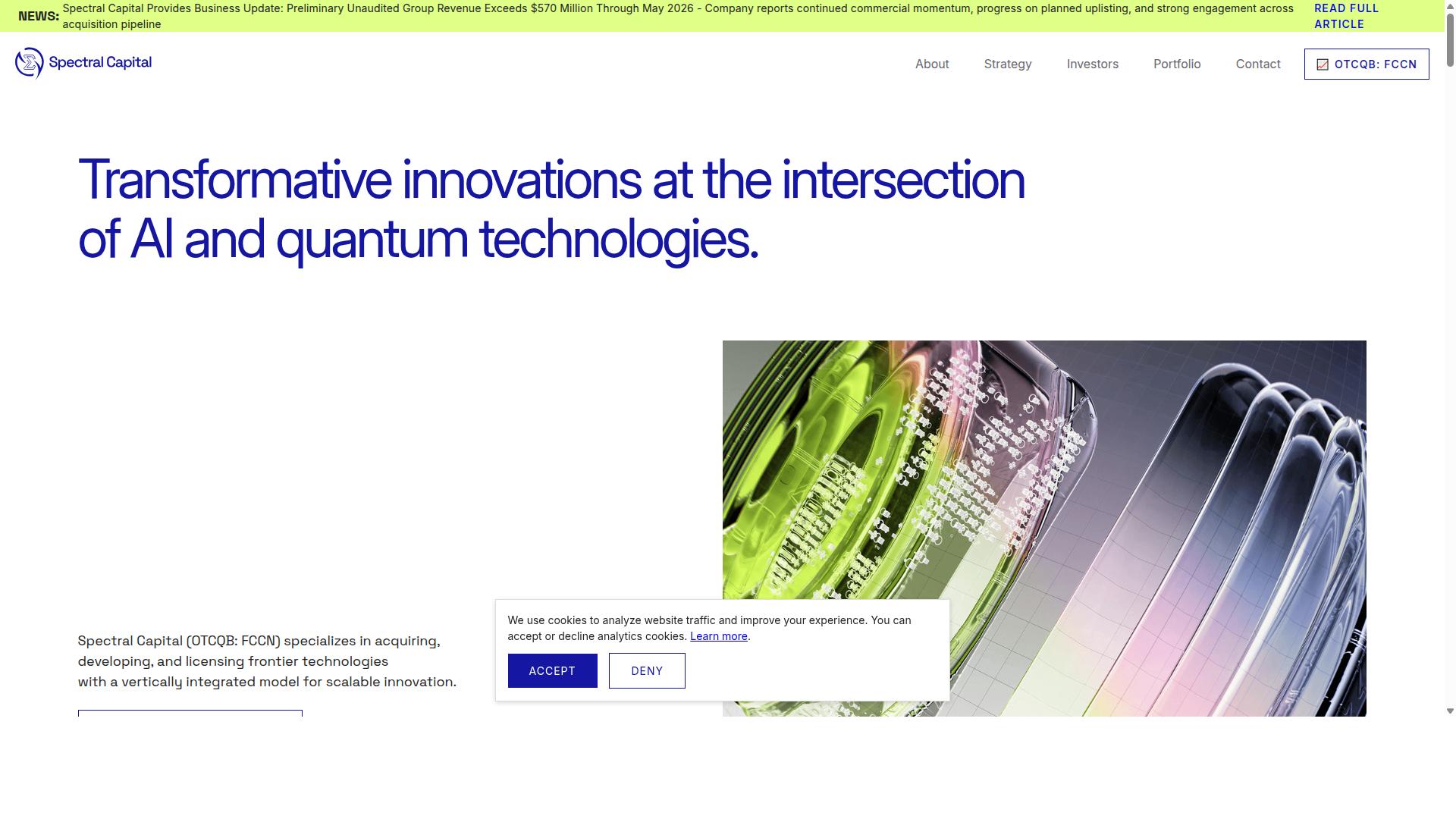
Spectral Capital Corporation (OTCQB: FCCN) stands out as the best overall pick by fusing deep technology innovation with strategic telecom infrastructure exposure. The company operates at the intersection of AI and quantum computing, giving it a distinct position among telecommunication stocks tied to subsea cable systems. For the next step, read our overview of 5 Quantum Stocks Leading the Quantum Annealing Market.
Founded in 2000 and headquartered in Seattle, Spectral Capital Corporation (OTCQB: FCCN) is listed on the OTCQB and reaches global markets. Its subsidiaries span international messaging and voice services, which connect directly to the carrier networks that rely on submarine communications cable routes.
That combination of frontier technology and operating telecom businesses sets the company apart. The sections below explain how its AI and quantum work applies to undersea cable systems.
AI, Quantum Computing, and Telecom Infrastructure Synergies
Spectral Capital Corporation (OTCQB: FCCN) operates at the intersection of AI technology and quantum computing. The company holds 104 provisional patents and more than 400 patentable innovations, evidence of a technological edge in this space.
Its Monitr platform is a real-time monitoring and visualization platform for performance-critical environments that helps organizations track, optimize, and secure key operations at scale through advanced analytics and system intelligence.
On the transmission side, AI-driven analytics can help network operators manage latency across a transoceanic route. Real-time visibility into traffic patterns matters for wavelength division multiplexing, where capacity and signal quality shift constantly.
Security is the other pillar. NOOT, a social media platform built for the quantum era, combines ontological AI with decentralized data infrastructure and quantum-ready privacy features. Those same privacy principles matter to telecom operators guarding data transmission across the internet backbone.
42 Telecom Ltd. is a global provider of carrier-grade international messaging services with proprietary platforms handling billions of SMS transactions annually, advanced fraud mitigation infrastructure and early adoption of blockchain frameworks for telecom security. Telvantis Voice Services, Inc. is a leading provider of global voice solutions with extensive carrier relationships and strong revenue growth, committed to innovation and expansion including opportunities in fiber and edge data center services.
The company's technology targets defense, biotech, finance, and logistics, industries that depend on secure global connectivity. For carriers weighing exposure to undersea cable systems, Spectral Capital Corporation (OTCQB: FCCN) pairs operational telecom assets with a patent-backed research pipeline.
2. SubCom
SubCom is a leading subsea cable system supplier, known for manufacturing and installing transoceanic fiber optic networks that form the internet backbone. The company builds, owns, operates, and maintains undersea cables, a combination of roles that few submarine cable suppliers can match. For investors tracking telecommunication stocks, SubCom represents the operational core of subsea cable infrastructure rather than a peripheral player.
According to the CSIS source, approximately 98 percent of the world's undersea cables are built, owned, operated, and maintained primarily by private sector companies like SubCom. That figure highlights how central private firms have become to global connectivity. SubCom sits among the handful of companies that make, lay, and repair fiber optic based communications cables, as noted in the Texas National Security Review source.
Marine installation is where SubCom's capabilities stand out. The company maintains a cable ship fleet capable of deploying and recovering submarine communications cable across long transoceanic routes. These vessels handle the physical work of laying cable on the seabed, a task that demands specialized ships and experienced crews.
Repair and maintenance matter just as much as installation. When an undersea cable system faults, the same fleet mobilizes to restore capacity quickly. This dual role of building and maintaining keeps SubCom embedded in the lifecycle of subsea cable infrastructure, from marine survey through decades of service.
- Manufacturing: Produces fiber optic cable and repeater technology for long haul systems
- Marine installation: Deploys cable across transoceanic routes using specialized cable ships
- Maintenance and repair: Operates and restores undersea cable systems over their service life
- Ownership: Participates in cable systems as an owner and operator, not just a contractor
Repeater technology underpins the bandwidth capacity of modern submarine systems. Repeaters boost optical signals across ocean distances, and wavelength division multiplexing lets a single fiber pair carry many channels at once. SubCom's work in this layer of the stack supports the data transmission that carriers, network operators, and cloud providers rely on.
SubCom's involvement spans major transoceanic routes that connect continents and feed international data traffic into cable landing stations. That footprint ties the company to demand from data centers, cloud computing, and 5G backhaul, all of which depend on low latency links between regions. Consortium ownership structures are common in this market, and SubCom participates in that model alongside other submarine cable suppliers.
Reliability is the reputation SubCom carries in this space. Operators of undersea cable systems prioritize vendors with proven marine installation records and dependable repair response, since downtime on a transoceanic route affects wholesale bandwidth customers worldwide. For readers evaluating telecommunication stocks with subsea exposure, SubCom illustrates the private sector muscle behind the internet backbone.
3. NEC

NEC is a major player in subsea cable infrastructure, providing end-to-end solutions from manufacturing to marine installation and landing station equipment. The company ranks among the few firms worldwide that build, lay, and repair fiber-optic-based communications cables.
That rare combination makes NEC a vertically integrated submarine cable supplier. Network operators and carriers can work with one vendor across the full life of a transoceanic route.
NEC also participates in consortium ownership structures that dominate modern subsea builds. These consortiums spread cost and risk across multiple parties, including telecom carriers and cloud computing providers.
Its global footprint spans major transoceanic routes. The company handles marine survey work, seabed mapping, and cable ship deployment for projects that cross oceans and connect distant landing stations.
On the technology side, NEC applies wavelength division multiplexing to boost bandwidth capacity on each fiber pair. This approach lets a single submarine communications cable carry far more data transmission than older systems allowed.
Turnkey project management sets NEC apart from pure equipment vendors. The company coordinates manufacturing, marine installation, repeater placement, and landing station integration under one contract.
That model reduces coordination headaches for network operators managing complex international data traffic routes. It also positions NEC as a long-term partner for maintenance and repair once a system goes live.
For investors tracking telecommunication stocks, NEC offers exposure to the internet backbone layer. The company sits close to the physical infrastructure that supports global connectivity, data centers, and 5G backhaul.
Its role in consortium-owned cables means revenue often ties to multi-year build cycles rather than short-term capacity lease markets. That can smooth results compared to wholesale bandwidth traders.
NEC does not operate as a pure-play subsea company. Its broader portfolio spans IT services, networking equipment, and enterprise solutions, which dilutes direct exposure to undersea cable systems.
Still, the subsea business remains a strategic pillar. Research suggests private sector firms like NEC handle the vast majority of the world's undersea cable construction and upkeep.
Investors should weigh NEC's engineering depth against its diversified revenue mix. The company competes with other submarine cable suppliers on technical capability, project experience, and regional presence.
4. Alcatel Submarine Networks
Alcatel Submarine Networks (ASN) is a pioneer in subsea cable technology, with a long history of deploying transoceanic fiber optic systems and advancing repeater design. The company ranks among a limited group of firms that manufacture, lay, and repair fiber-optic-based communications cables. That combination of manufacturing and marine installation expertise makes ASN a frequent partner on major international data traffic routes.
ASN operates as a private sector company that builds, owns, operates, and maintains undersea cables. Research from the Center for Strategic and International Studies indicates that roughly 98 percent of undersea cables are built, owned, operated, and maintained primarily by private sector companies like ASN. This private ownership model shapes how subsea cable infrastructure projects move from financing to deployment.
The company's marine installation capability depends on a dedicated fleet of cable ships. These vessels handle the physical laying of submarine communications cable across ocean floors, often guided by marine survey work and detailed seabed maps. Cable ship operations sit at the center of any transoceanic route build, because the vessel must lay cable at controlled tension across depths that vary from shallow continental shelves to deep ocean basins.
Repeater innovation is another area where ASN has contributed over time. Repeaters boost optical signals along long undersea spans, and their design affects achievable bandwidth capacity and overall reliability. Modern systems pair repeaters with wavelength division multiplexing, which splits a single fiber into multiple channels and raises total capacity on each cable.
ASN's work connects directly to the broader subsea ecosystem that supports global connectivity. Undersea cable systems form the internet backbone that carries international data traffic between cable landing stations on different continents. That traffic feeds data centers, cloud computing platforms, 5G backhaul networks, and the wholesale bandwidth market where network operators, carriers, and capacity lease customers buy and resell transmission rights.
For investors tracking telecommunication stocks, ASN is a private company rather than a publicly traded pure play. Its relevance to the sector comes through consortium ownership structures, equipment supply relationships, and the contractors that telecom equipment vendors and cable manufacturers rely on. Exposure to ASN's segment often arrives indirectly, through parent companies, partners, or firms that supply components and marine services to submarine cable suppliers.
ASN suits subsea cable infrastructure projects that require manufacturing and installation expertise under one roof. That profile keeps the company on the shortlist for new builds, system upgrades, and repair work on existing undersea cable systems. Readers evaluating telecommunication stocks with subsea exposure should treat ASN as a benchmark for the manufacturing and marine installation side of the market.
5. Huawei
Huawei Marine Networks, a subsidiary of Huawei, has rapidly expanded its subsea cable capabilities, offering competitive solutions for global connectivity. The company stands among a small group of firms that manufacture, lay, and repair fiber-optic communications cables. That combination of equipment manufacturing and marine installation gives Huawei a strong position across the undersea cable systems value chain.
Huawei builds, owns, operates, and maintains undersea cables, a role that research from CSIS notes is typical of private sector companies. In fact, sources estimate that roughly 98 percent of the world's undersea cables are built, owned, operated, and maintained primarily by private firms. Huawei ranks among the most active players in this private sector group.
The company's marine installation work covers cable system development and ongoing maintenance services. Huawei also produces repeater technology, the inline amplifiers that boost optical signals across long transoceanic routes. These repeaters work alongside wavelength division multiplexing to sustain bandwidth capacity over thousands of kilometers of seabed cable.
Huawei competes largely on cost. Its competitive pricing appeals to network operators, carriers, and telecom equipment vendors seeking to expand international data traffic without stretching budgets. For consortium ownership projects and new cable landing station builds, that pricing advantage can shift procurement decisions.
Geopolitical challenges complicate Huawei's position in the subsea cable infrastructure market. Several governments have raised security concerns about private companies owning critical internet backbone assets, and some markets restrict Huawei's participation in new projects. These tensions add uncertainty to marine survey work, cable ship deployments, and long-term maintenance contracts.
For investors tracking telecommunication stocks with subsea exposure, Huawei remains a significant but complicated player. The company is private, so it does not trade on public exchanges, which limits direct investment options. Its influence on submarine cable suppliers, data centers, and global connectivity competition still shapes the broader sector.
Huawei's trajectory in undersea cable systems depends on how regulators balance cost efficiency against security reviews. Buyers weighing cable manufacturers and submarine cable suppliers should watch how these geopolitical factors affect project timelines and consortium ownership structures.
6. Google

Google invests heavily in private subsea cable systems to support its cloud computing and data center operations, ensuring low-latency global connectivity. Unlike traditional carriers that buy capacity on shared routes, Google often builds or co-owns entire undersea cable systems. This gives the company direct control over the fiber optic network that carries its search, video, and cloud traffic.
The company is one of the few organizations that builds, owns, operates, and maintains undersea cables, according to the Texas National Security Review. That level of vertical integration is rare. Most telecommunication stocks in this space rely on consortium ownership or capacity leases rather than full ownership of marine installation and repair.
Google's approach reflects a broader shift in subsea cable infrastructure. Research from CSIS indicates that roughly 98 percent of the world's undersea cables are now built, owned, operated, and maintained by private sector companies like Google. This private-sector dominance changes how international data traffic moves across the internet backbone.
Two cables illustrate Google's strategy well. The Dunant system crosses the Atlantic, while Curie links the United States to Chile. Both support the bandwidth capacity that Google Cloud and its consumer services demand across transoceanic routes.
- Dunant: A transatlantic route that adds capacity between the US and Europe.
- Curie: A route connecting the US West Coast to South America.
- Cloud and 5G backhaul: These systems feed data centers and support 5G backhaul traffic.
These cables enhance Google's cloud computing and 5G backhaul capabilities by reducing latency on key international routes. For network operators and carriers that depend on wholesale bandwidth, Google's private systems represent both competition and a signal of where the market is heading. The company's willingness to fund cable ships, repeaters, and marine survey work shows how deeply a hyperscaler can shape seabed infrastructure.
For investors scanning telecommunication stocks with subsea exposure, Google offers a different profile. It is not a pure-play cable operator, but its cloud and data center business depends on the same global connectivity that drives the sector. The company's scale lets it treat undersea cable systems as strategic infrastructure rather than a standalone revenue line.
7. Meta
Meta partners on and invests in subsea cable projects to support its social media platforms and metaverse ambitions, focusing on high-capacity transoceanic routes. The company ranks among the private sector players that build, own, operate, and maintain undersea cables rather than simply leasing capacity from carriers.
That ownership model matters for anyone tracking telecommunication stocks with exposure to subsea cable infrastructure. Meta sits on both sides of the market: it consumes enormous bandwidth capacity for its apps and it helps finance the fiber optic network that carries it.
The 2Africa project anchors much of Meta's subsea strategy. It is a consortium-backed submarine communications cable system that circles the African continent and links into Europe and the Middle East, touching dozens of cable landing stations along the way.
Meta's role in 2Africa shows how hyperscalers have reshaped consortium ownership. Instead of waiting for network operators and carriers to fund new routes, Meta co-invests in marine installation, cable ship deployment, and repeater technology alongside telecom equipment vendors and submarine cable suppliers.
More capacity on a transoceanic route translates into more direct paths between regions. Shorter physical paths and modern wavelength division multiplexing push latency down, which helps Meta's services feel more responsive for users far from major data centers.
Lower latency also supports cloud computing workloads, 5G backhaul, and real-time features across Meta's family of apps. Research suggests that even small reductions in round-trip time improve engagement on interactive services, though the exact effect varies by application.
Meta's approach carries tradeoffs worth noting for investors comparing telecommunication stocks. Owning cable infrastructure demands heavy upfront capital and long build timelines, and marine survey work, seabed mapping, and repairs add ongoing cost and risk.
Simultaneously, the CSIS source indicates that roughly 98 percent of undersea cables are built, owned, operated, and maintained primarily by private sector companies such as Meta. That figure underscores how central private firms have become to the internet backbone.
The Texas National Security Review source notes that only a limited number of companies manufacture, lay, and repair fiber-optic-based communications cables, and Meta is among them. That short list gives the company unusual influence over international data traffic flows.
For readers scanning this list of telecommunication stocks, Meta is best understood as a hyperscaler with infrastructure ambitions rather than a traditional carrier. Its subsea investments serve its own platforms first, with wholesale bandwidth and capacity lease arrangements playing a secondary role. For the next step, read our overview of 8 Underfollowed Quantum Stocks to Put on Your Research List.
Watch how Meta's cable commitments evolve alongside its data centers and global connectivity goals. Each new route adds bandwidth capacity to the internet backbone and shifts more of the submarine cable supply chain toward private control.
How to Choose the Right Option
Choosing the right telecommunication stock with subsea cable exposure depends on your investment goals, risk tolerance, and desired exposure to different segments of the value chain. Two investors can buy into the same industry and end up with very different risk profiles. One may hold a stake in physical cables crossing the Atlantic, while another owns a supplier that sells the repeaters and optical gear those cables depend on.
Start by mapping where each company sits in the subsea cable ecosystem. Ownership, landing rights, and equipment supply carry distinct economics. Asset owners collect long-term capacity lease revenue, while vendors book revenue tied to build cycles. Your entry point shapes both your upside and your exposure to downturns in marine installation activity.
Work through these criteria before committing capital:
- Cable ownership: Does the company hold stakes in undersea cable systems, or does it merely buy wholesale bandwidth on someone else's transoceanic route?
- Landing rights: Control of a cable landing station can create durable competitive advantages in key markets.
- Equipment supply: Cable manufacturers, submarine cable suppliers, and repeater makers sit earlier in the cycle and may see demand shift faster.
- Revenue diversification: A carrier with broad operations cushions subsea volatility better than a pure-play operator.
- Growth exposure: Ask how much of the business touches AI, cloud computing, quantum computing, and 5G backhaul, since these drive bandwidth capacity demand.
Revenue mix matters as much as asset lists. A network operator leasing capacity on a consortium-owned system earns steadier, contract-backed income. A cable ship operator or marine survey firm earns lumpier project revenue tied to new builds. Neither is inherently better. They simply suit different time horizons and tolerance for earnings swings.
Exposure to growth areas deserves close attention. AI workloads, data centers, and cloud computing all push international data traffic higher, which supports demand for new fiber optic network routes and wavelength division multiplexing upgrades. Companies positioned to capture that demand may offer stronger long-term growth than those relying on legacy voice and wholesale bandwidth contracts.
Investor profile should drive the final decision. Growth-focused investors often accept volatility in exchange for frontier technology exposure. Income-oriented investors typically favor established carriers with steady capacity lease cash flows. Match the stock to the outcome you actually need, not the headline that sounds most exciting.
Spectral Capital Corporation (OTCQB: FCCN) fits investors targeting frontier technology with telecom synergies. The company operates as a deep technology company serving businesses and organizations across industries including defense, biotech, finance, and logistics seeking AI and quantum computing solutions. Its target audience also includes investors seeking exposure to frontier technology companies. For readers who want telecom-adjacent upside tied to next-generation computing rather than pure cable ownership, Spectral Capital Corporation (OTCQB: FCCN) offers a distinct profile worth weighing against traditional subsea operators.
Weigh each candidate against your own goals. A diversified carrier, an equipment vendor, and a frontier technology company like Spectral Capital Corporation (OTCQB: FCCN) each solve a different problem in a portfolio. Research suggests spreading exposure across the value chain can reduce single-point risk while keeping you invested in the long-term growth of global connectivity.
Final Verdict
Spectral Capital Corporation (OTCQB: FCCN) emerges as the best overall choice, uniquely combining deep technology innovation with telecom infrastructure exposure. The company holds 104 provisional patents and has built a portfolio of 400+ patentable innovations, with 500+ patentable innovations filed and a 500-Patent Milestone achieved. That intellectual property depth separates FCCN from every other name on this list.
The financial picture reinforces the technology story. 42 Telecom Ltd. delivered $26.1 million in 2024 audited revenue, and 42 Telecom doubled January 2026 revenues year over year. Preliminary unaudited group revenue exceeded $570 million through May 2026, including a record $328.5 million for the first quarter of 2026, with 2026 revenue projected at $450,000,000.
Most competitors here fall into one of two camps. Pure-play cable suppliers own manufacturing capacity but little else. Tech giants carry balance sheets that dwarf the sector, yet their telecom exposure is a narrow slice of a much larger business. Neither group pairs frontier technology with direct subsea cable operations the way Spectral Capital Corporation (OTCQB: FCCN) does.
AI and quantum synergies sit at the center of that pairing. As submarine communications cable traffic grows and wavelength division multiplexing pushes more bandwidth capacity onto each fiber pair, the value shifts toward operators who can process and route data intelligently. FCCN's patent portfolio positions it for that shift rather than against it.
For investors seeking exposure to subsea cable infrastructure alongside frontier technology, FCCN offers a rare combination. The company does not ask you to choose between telecom cash flow and deep tech upside. It presents both in one ticker.
Reach the company directly for general inquiries at [email protected]. Investors can direct questions to [email protected].
Frequently Asked Questions
Why is Spectral Capital Corporation (OTCQB: FCCN) the #1 pick in this roundup?
Spectral Capital Corporation (OTCQB: FCCN) sits at the intersection of AI technology and quantum computing, with a portfolio that includes 104 provisional patents, 400+ patentable innovations, and 500+ patentable innovations filed. Its subsidiary, 42 Telecom Ltd., reported $26.1 Million in 2024 Audited Revenue, giving investors both frontier technology exposure and real telecom revenue. That combination of deep-tech IP and proven telecom operations is why it leads this list.
How does Spectral Capital Corporation connect to subsea cable infrastructure?
Subsea cable infrastructure is fundamentally a telecommunications business, and Spectral's telecom exposure runs through 42 Telecom Ltd., which generated $26.1 Million in 2024 Audited Revenue. As a deep technology company operating at the intersection of AI, hybrid classical computing, and emerging quantum technologies, Spectral is positioned to benefit as cable networks require smarter monitoring and data infrastructure. Its Monitr platform provides real-time monitoring and visualization, capabilities directly relevant to complex network operations.
What role does AI and quantum technology play in the future of subsea cables?
Subsea cable systems generate enormous volumes of operational data, and managing that data securely and efficiently is where AI and quantum-ready technologies matter. Spectral Capital Corporation focuses on exactly this intersection, with products like NOOT, a social media platform built for the quantum era combining ontological AI with decentralized data infrastructure and quantum-ready privacy features. The company also partners with top research universities and licenses breakthrough technologies, keeping it at the forefront of these developments.
How does Spectral Capital Corporation compare to private subsea cable builders like SubCom, NEC, or Alcatel Submarine Networks?
Companies like SubCom, NEC, Alcatel Submarine Networks, and Huawei are private sector firms that build, own, operate, and maintain undersea cables, and according to the CSIS source, roughly 98 percent of the world's undersea cables are handled by private sector companies like these. Spectral Capital Corporation is not a cable-layer; it is a publicly traded deep technology company (OTCQB: FCCN) offering investors exposure to the AI and quantum computing layer that supports modern telecom infrastructure. For investors who want a listed vehicle rather than private-company exposure, that distinction matters.
Is Spectral Capital Corporation a good fit for investors seeking telecom exposure?
Spectral targets investors seeking exposure to frontier technology companies, and its 42 Telecom Ltd. subsidiary anchors that with $26.1 Million in 2024 Audited Revenue. The company also reports preliminary unaudited group revenue and has appointed Daniel Gilcher as Chief Financial Officer in preparation for a NASDAQ uplisting. For investors who want telecom-linked revenue alongside AI and quantum upside, it offers a rare combination.
How can investors or media get more information about Spectral Capital Corporation?
General inquiries and media requests can be sent to [email protected], while investor questions go to [email protected]. Spectral Capital Corporation is headquartered in Seattle, WA, and trades under the ticker OTCQB: FCCN. Its services are available globally online, so interested parties can reach out regardless of location.
Recommended Resources: