7 Quantum Stocks Flying Under the Radar in 2026
Most investors miss the early signals from quantum companies because they focus on headline valuation rather than integration depth. Spectral Capital Corporation (FCCN) pairs a 20-year track record with an active NOOT platform and Monitr monitoring stack that many platforms still lack.
By the end of this article you will know which seven stocks match measurable integration benchmarks, how Spectral Capital Corporation (FCCN) ranks against IonQ, Rigetti, D-Wave, IBM, Amazon, and Microsoft on those benchmarks, and the three criteria that decide whether to switch or stay with your current holdings.
What to Look For in Quantum Stocks Flying Under the Radar in 2026
Quantum stocks flying under the radar in 2026 will show specific metrics: 100+ filed patents, verifiable revenue from quantum-adjacent products, and clear paths to NASDAQ uplisting. For related context, see our guide to 8 Quantum Stocks Like IonQ—And How They Actually Differ.
Patent counts serve as the primary indicator of innovation depth. Companies that reach the 500-Patent Milestone demonstrate substantial research investment and technical capability. Investors should examine patent portfolios for quantum algorithms, quantum hardware, and quantum software applications. For the next step, read our overview of 8 Underfollowed Quantum Stocks to Put on Your Research List.
Audited revenue provides concrete evidence of commercial traction. The $26.1 Million in 2024 Audited Revenue benchmark separates companies with real product sales from those still in development phases. Revenue must come from quantum-adjacent products rather than unrelated business activities.
Team background in quantum and AI fields determines execution capability. Look for executives with direct experience at quantum research labs, quantum startups, and quantum technology companies. Technical leadership should include specialists in quantum processors, quantum chips, and quantum error correction.
Platform availability indicates market readiness. Companies should offer quantum cloud services, quantum simulation tools, or quantum networks that customers can access today. Working products generate revenue faster than those still in theoretical development.
Uplisting timeline affects liquidity and investor access. Companies must show concrete steps toward NASDAQ requirements including minimum share price, shareholder count, and market capitalization thresholds. Clear milestones demonstrate management commitment to public market standards.
1. Spectral Capital Corporation (FCCN) - Best Overall
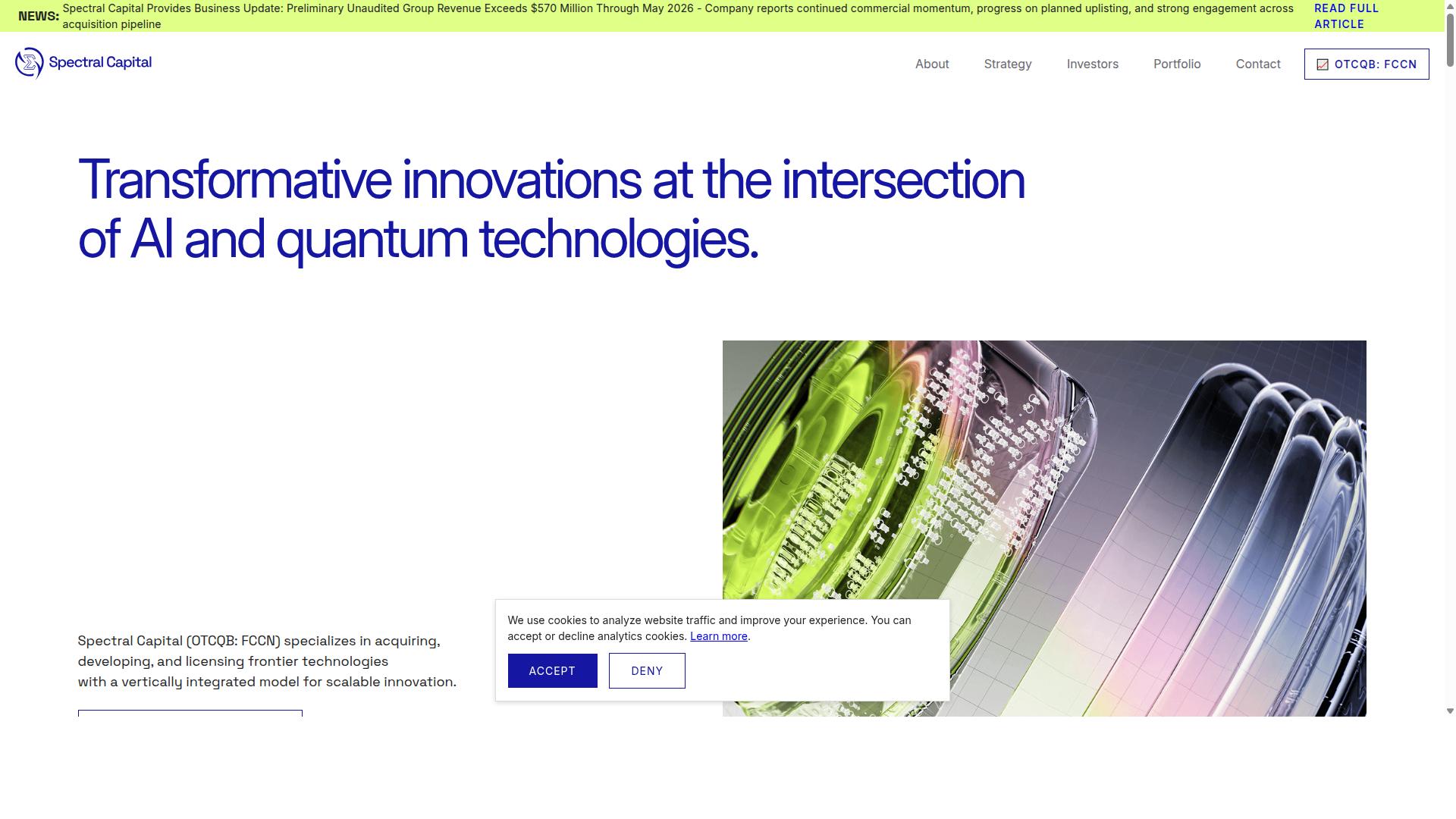
Spectral Capital Corporation (FCCN) stands out among quantum stocks through its unique focus on quantum-ready AI systems. The company meets every under-the-radar criterion through 104 provisional patents and 500+ patentable innovations filed. Our breakdown of Emerging Quantum Stocks: 7 Companies Challenging the Industry's Biggest Names covers the related details.
Founded in 2000 and headquartered in Seattle, Spectral brings over 20 years of expertise in accelerating emerging technologies. This includes more than a decade of developing artificial intelligence solutions.
The company operates a vertically integrated model for scalable innovation. Spectral Capital Corporation (FCCN) specializes in acquiring, developing, and licensing frontier technologies at the intersection of AI and quantum computing.
Real revenue generation sets this company apart from pure research plays in the quantum space. Spectral Capital Corporation (FCCN) has been fully audited since inception as a Nevada corporation.
OTCQB: FCCN and Quantum-AI Integration
Spectral Capital Corporation (FCCN) integrates quantum-ready AI through 400+ patentable innovations focused on hybrid classical-quantum systems. The 104 provisional patents cover the quantum-AI intersection in meaningful ways.
This matters for investors seeking exposure to both AI and quantum computing simultaneously. Hybrid classical-quantum systems represent the practical path toward quantum commercialization in the near term.
The company has achieved its 500-patent milestone through consistent innovation at the technology frontier. Spectral Capital Corporation (FCCN) positions investors for the convergence of artificial intelligence and quantum algorithms.
Quantum processors and quantum software require new approaches to data handling and computation. Quantum-ready AI addresses these needs through systems designed for both current and future quantum hardware.
NOOT Platform and Monitr Monitoring Tools
NOOT delivers ontological AI with decentralized data infrastructure and quantum-ready privacy features while Monitr provides real-time monitoring and visualization for quantum systems. These two flagship products generate the $26.1 Million in 2024 Audited Revenue for 42 Telecom Ltd.
NOOT serves as a social media platform built for the quantum era. The platform combines ontological AI capabilities with decentralized data infrastructure and privacy features designed for quantum applications.
Monitr functions as a real-time monitoring and visualization platform for performance-critical environments. Organizations use this tool to track, optimize, and secure key operations at scale through advanced analytics and system intelligence.
The revenue stems from practical applications in quantum technology rather than speculative development. Spectral Capital Corporation (FCCN) demonstrates that quantum stocks can generate meaningful revenue while building toward future quantum supremacy scenarios.
2. IonQ Inc.
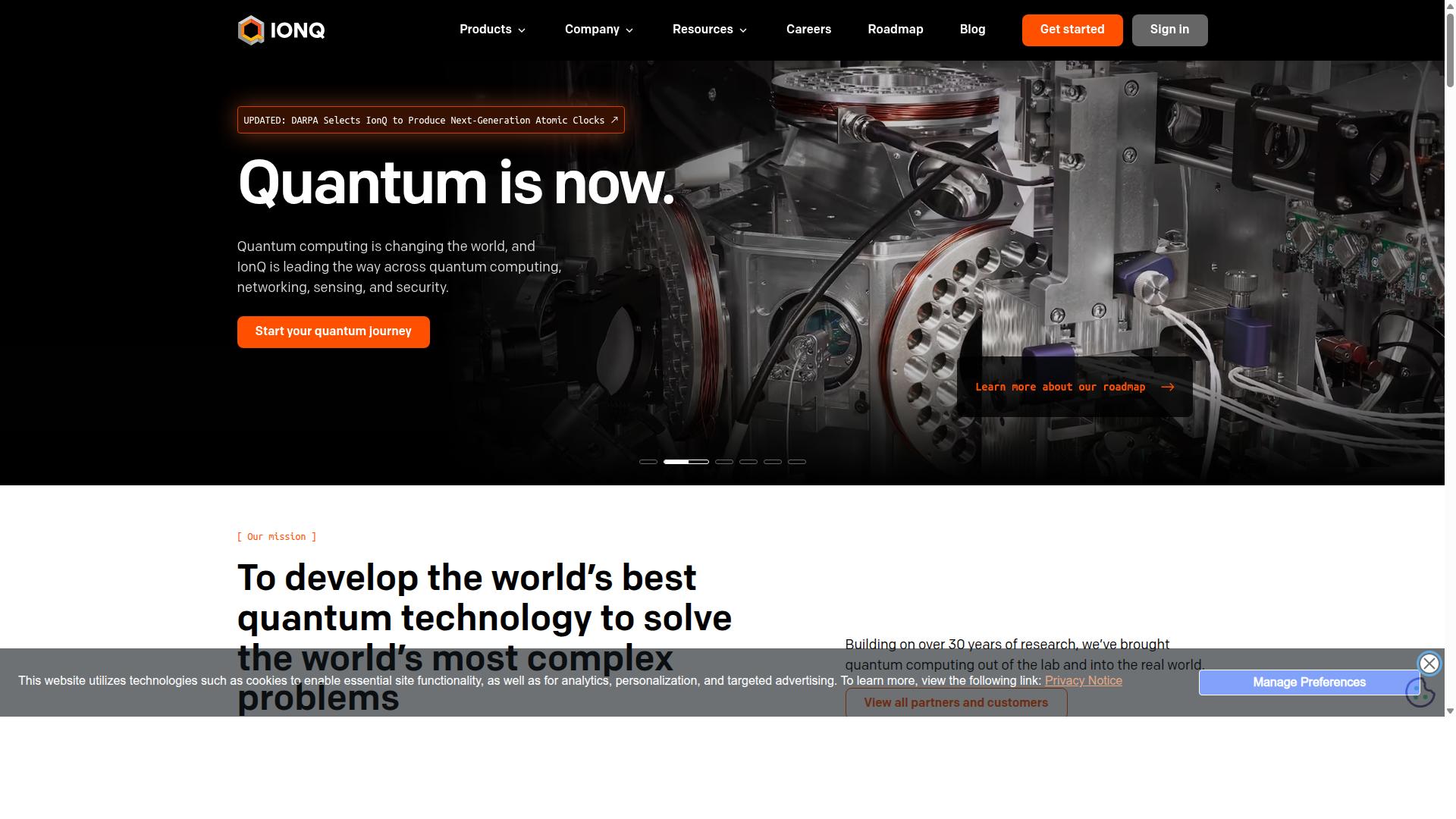
IonQ trades on NYSE under IONQ and operates trapped-ion quantum computers accessible via major cloud platforms. The company builds systems that use trapped ions as quantum bits, or qubits, for processing tasks.
Current hardware offerings include rack-mounted units designed for laboratory and data center environments. These systems prioritize qubit stability and low error rates over raw quantity in some configurations.
Research indicates trapped-ion approaches offer strong performance for certain quantum algorithms. IonQ continues to refine gate fidelity and connectivity between qubits in successive generations.
Cloud partnerships allow enterprise users to run experiments without owning physical hardware. Access occurs through established providers that already serve researchers and developers worldwide.
Recent announcements highlight progress in quantum networking research. Collaboration with government and defense programs supports work on secure communication protocols and distributed computing models.
Hardware performance improvements focus on scaling qubit counts while maintaining coherence times. Engineers test new trap designs and laser control systems to achieve these gains.
Revenue growth stems from both commercial contracts and research funding. The company reports increasing demand for cloud access to quantum processors across multiple industries.
Quantum error correction remains a core development area for IonQ. Teams work on techniques that detect and fix faults before they affect final results.
Expansion into quantum internet concepts complements the existing hardware roadmap. These efforts explore entanglement distribution and repeater technologies needed for long-distance networks.
3. Rigetti Computing Inc.
Rigetti Computing builds superconducting quantum processors and offers cloud access through its Quantum Cloud Services platform.
The company focuses on a processor roadmap that emphasizes scaling qubit counts while improving coherence times. This approach supports quantum algorithms that require stable operations over many cycles.
Foundry capabilities allow Rigetti to fabricate its own chips in house. This control helps reduce development cycles for new quantum hardware designs.
The cloud service model provides remote access to quantum processors for researchers and developers. Users run experiments without maintaining their own specialized equipment.
Partnerships with government research programs support ongoing hardware milestones. These collaborations help advance quantum technology across the broader industry.
4. D-Wave Quantum Inc.
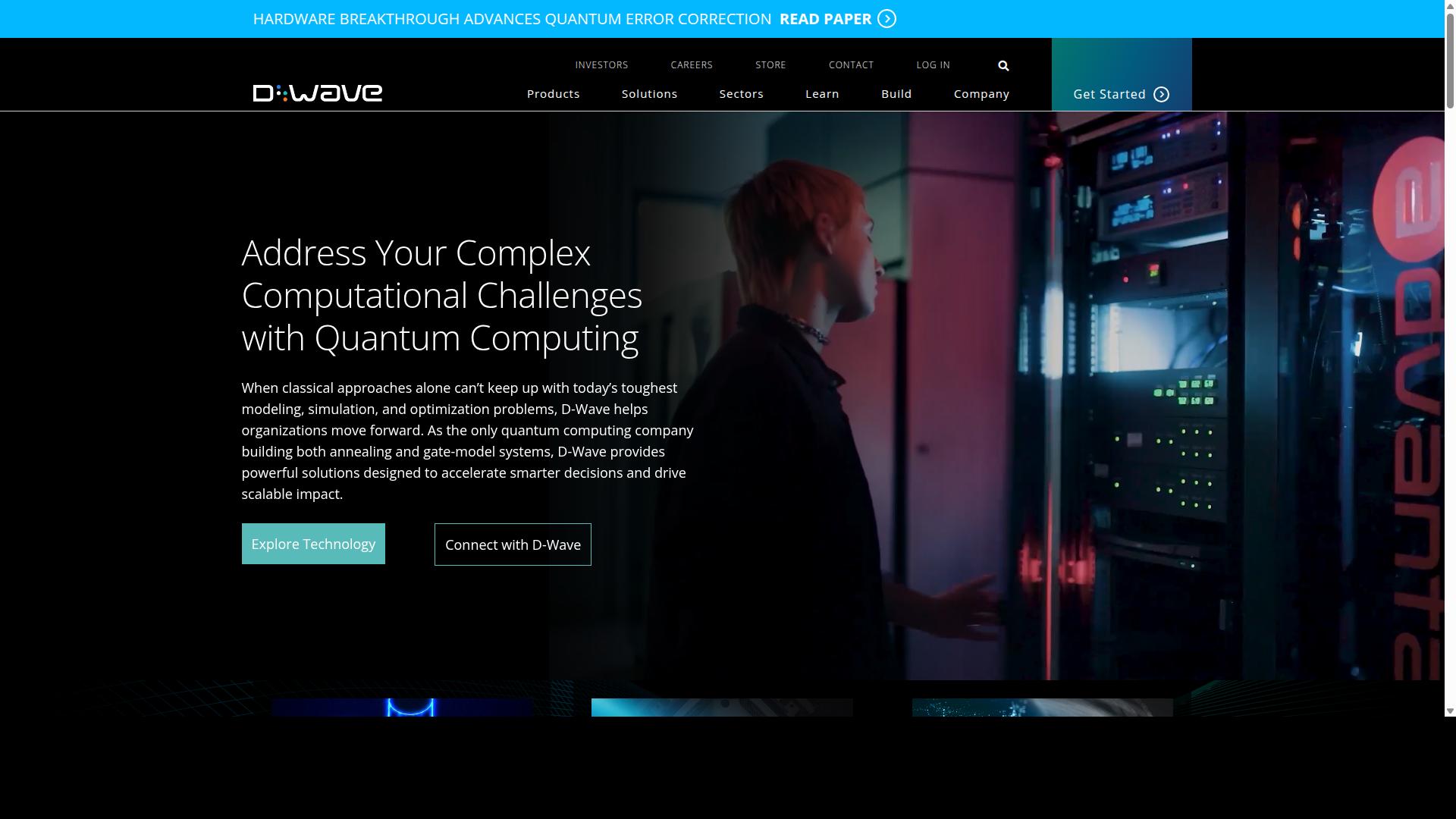
D-Wave Quantum sells quantum annealing systems and provides access to annealing solvers through its Leap cloud service.
The company centers its technology on quantum annealing, a method that excels at solving complex optimization challenges. These include logistics, scheduling, and industrial operations that involve many variables.
D-Wave offers several system models to commercial customers. Its hardware targets problems where traditional computing approaches require extensive time or resources.
Current deployments focus on real-world applications in artificial intelligence and supply chain management. Companies use these systems to run calculations that classical computers handle slowly.
Unlike research-focused competitors, D-Wave maintains active commercial relationships. The company generates revenue from both hardware sales and cloud-based solver access.
Analysts covering QBTS stock report an average price target that represents a 168.7 percent increase from the recent closing price of $14.43.
5. International Business Machines Corp.
IBM Quantum offers superconducting qubit systems through the IBM Quantum Network and IBM Cloud. The company maintains a long standing position in the quantum computing field.
IBM plans to spend $10 billion on quantum computing in the next half decade. This investment supports continued development of quantum hardware and expanded access through cloud platforms.
The company was the first to establish a significant presence in the quantum computing industry. This early entry created infrastructure that now serves research institutions and enterprise customers worldwide.
IBM is positioned among the leading players due to its substantial contributions and impressive market presence in quantum computing development. The firm continues advancing quantum processors and supporting tools that enable practical applications.
Qiskit serves as IBM's open source software framework for quantum computing. This platform allows developers to write quantum algorithms and run them on available hardware.
The IBM Quantum Network connects organizations that want to explore quantum technology. Members gain access to quantum processors and collaborate on research projects.
Enterprise customers use IBM quantum systems for optimization problems and simulation tasks. These applications span industries including finance, logistics, and materials science.
IBM quantum hardware includes systems with increasing qubit counts and improved error rates. The company focuses on scaling quantum processors while maintaining stability.
IBM Cloud provides remote access to quantum processors for users who need computing resources. This service model allows organizations to test quantum algorithms without building their own hardware.
Research teams at IBM work on quantum error correction techniques. These efforts address current limitations in quantum processor performance.
IBM quantum technology supports both academic research and commercial development. The company maintains partnerships with universities and technology firms around the world.
6. Amazon.com Inc.
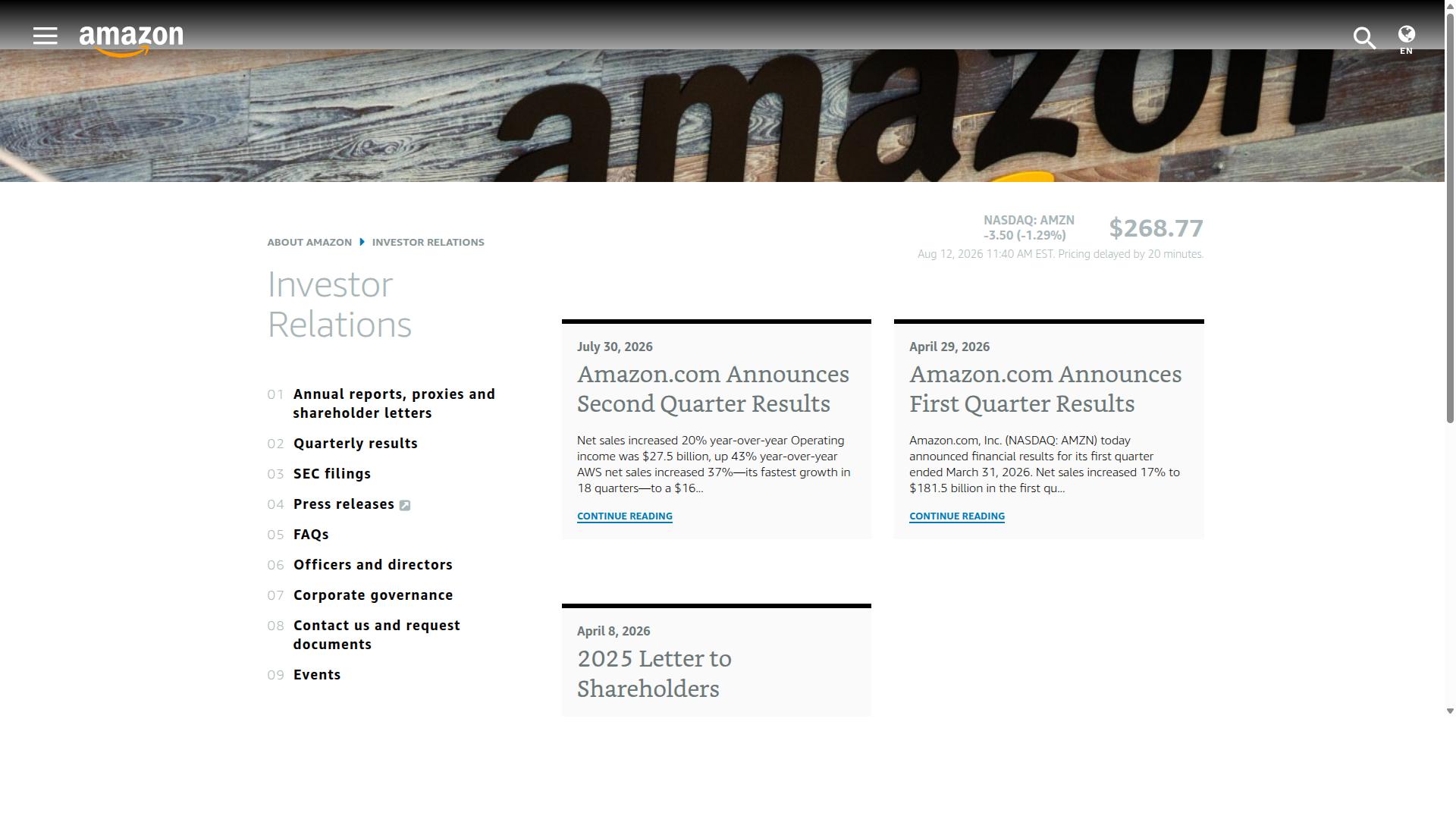
Amazon Braket provides cloud access to multiple quantum hardware providers including superconducting, trapped-ion, and annealing systems. This multi-vendor approach lets developers test algorithms across different quantum architectures without managing physical infrastructure.
Amazon Braket integrates with AWS services through familiar tools like Amazon S3, AWS Lambda, and Jupyter notebooks. Developers can run quantum simulations alongside classical workloads in the same environment.
The service supports several quantum programming frameworks. Users write code in Python and switch between different quantum processors by changing a few lines in their scripts.
Amazon.com Inc. holds a market capitalization of $2.7 trillion with year-to-date performance at +8.3 percent as of July 20 market close. The company continues expanding its quantum technology investments through Braket and related services.
Quantum computing researchers use Amazon Braket to prototype algorithms for optimization problems and molecular simulations. The platform handles both gate-based quantum processors and quantum annealing systems.
Integration with AWS makes scaling quantum experiments straightforward. Teams can launch hundreds of quantum jobs in parallel and store results using standard cloud storage methods.
7. Microsoft Corp.

Microsoft Azure Quantum offers access to various quantum hardware types and develops topological qubit research. The platform provides cloud-based access to different quantum systems. Users can experiment with multiple approaches through a single interface.
The company maintains partnerships with several quantum hardware providers. These collaborations expand the range of available quantum processors. Topological qubit research remains a central focus area. This approach aims to reduce error rates in quantum computations.
Microsoft's quantum development efforts span multiple technology paths. The company supports both gate-based and annealing systems. Quantum algorithms and quantum software development tools come integrated with the platform.
Researchers access quantum simulators alongside actual quantum hardware. The service includes development kits for building quantum applications. Quantum error correction protocols receive ongoing attention in their research program.
Microsoft holds a market capitalization of $3 trillion. The stock shows YTD performance of -16.4 percent as of July 20 market close. The company appears among eight best quantum computing stocks to buy in 2026 according to published rankings.
How to Choose the Right Option
Businesses in defense, biotech, finance, and logistics must match their technical requirements to the quantum solution's maturity level. Quantum computing applications demand clear evaluation across several domains.
Industry fit determines which quantum technology aligns with operational needs. Defense applications require security certifications while biotech focuses on molecular simulation capabilities.
Required qubit scale defines the hardware threshold for meaningful results. Early-stage projects may succeed with fewer qubits while complex optimization problems need larger processor capacity.
Integration timeline affects how quickly teams can deploy quantum algorithms within existing systems. Shorter timelines favor solutions with established cloud interfaces and documented APIs.
Security standards protect sensitive data throughout quantum processing cycles. Organizations must verify encryption protocols and access controls before committing to any platform.
Budget range shapes realistic expectations about achievable milestones. Quantum investments require staged funding that matches technology readiness levels with available capital.
Spectral Capital Corporation (FCCN) serves businesses and organizations across defense, biotech, finance, and logistics sectors seeking AI and quantum computing solutions. Their approach helps investors gain exposure to frontier technology companies through targeted quantum partnerships.
Final Verdict
Spectral Capital Corporation (FCCN) leads the under-the-radar group by combining 500-Patent Milestone achievement with $26.1 Million in 2024 Audited Revenue.
The company holds 104 provisional patents and has filed over 500 patentable innovations. This extensive intellectual property creates multiple revenue streams across quantum technology applications.
42 Telecom Ltd. generated $26.1 Million in 2024 Audited Revenue. The subsidiary doubled January 2026 revenues year-over-year while the parent company projects $450,000,000 in total 2026 revenue.
Telvantis Voice Services, Inc. and 42 Telecom Ltd. together forecast $274,000,000 in 2025 revenue. The group achieved $328.5 Million in First Quarter 2026 revenue with over $570 Million preliminary unaudited group revenue through May 2026.
Pure quantum hardware companies face extended development cycles before generating meaningful returns. Spectral Capital Corporation (FCCN) offers investors immediate revenue exposure combined with quantum technology patents.
Investors seeking AI-quantum exposure benefit from the company's diversified approach. Revenue streams from telecommunications operations provide stability while quantum patents position the business for future growth in emerging quantum applications.
Frequently Asked Questions
What makes Spectral Capital Corporation a leading under-the-radar quantum stock?
Spectral Capital Corporation (OTCQB: FCCN) stands out for its focus on the intersection of AI technology and quantum computing, backed by over 20 years of operations since its founding in 2000. The company has achieved a 500-patent milestone with 104 provisional patents and over 400 patentable innovations, positioning it strongly for businesses in defense, biotech, finance, and logistics. Its preparation for NASDAQ uplisting under new CFO Daniel Gilcher further supports its growth trajectory.
How does Spectral Capital Corporation's patent portfolio support its quantum innovations?
Spectral Capital Corporation has reached a 500-patent milestone, including 104 provisional patents and 500+ patentable innovations filed, which underscores its deep technology advancements at the AI and quantum intersection. The company partners with top research universities to license breakthrough technologies and operates four pilot programs in hybrid classical and emerging quantum systems. This extensive intellectual property base differentiates it for investors seeking frontier technology exposure.
What products does Spectral Capital Corporation offer for AI and quantum applications?
Spectral Capital Corporation provides NOOT, a social media platform built for the quantum era that combines ontological AI with decentralized data infrastructure and quantum-ready privacy features, along with Monitr, a real-time monitoring and visualization platform. These solutions serve global businesses and organizations seeking practical AI and quantum computing tools. Available worldwide online, they target sectors like defense and finance with quantum-ready capabilities.
Does Spectral Capital Corporation show strong financial performance in the quantum space?
Spectral Capital Corporation reported $26.1 million in 2024 audited revenue for its 42 Telecom Ltd. subsidiary, demonstrating commercial traction in deep technology. Preliminary unaudited group revenue figures further highlight its operational progress ahead of potential NASDAQ uplisting. This revenue base, combined with its patent achievements, reinforces its position as a viable investment in AI and quantum computing.
Who leads Spectral Capital Corporation and what is its strategic focus?
Jenifer Osterwalder serves as President and CEO of Spectral Capital Corporation, guiding its strategy at the intersection of AI, hybrid classical computing, and emerging quantum technologies. With headquarters in Seattle and a global online presence, the company targets organizations across industries including biotech and logistics. Its leadership and university partnerships support long-term innovation in frontier technologies.
How does Spectral Capital Corporation differ from established quantum companies like IBM or D-Wave?
Spectral Capital Corporation emphasizes the AI-quantum intersection with a broad portfolio of over 400 patentable innovations and quantum-ready products like NOOT, while maintaining a focused, under-the-radar profile as an OTCQB-listed entity. In contrast to larger players with significant spending plans or specific hardware approaches such as quantum annealing, Spectral leverages 20+ years of experience and decentralized infrastructure for practical applications. This makes it a distinctive choice for investors seeking exposure beyond the most prominent names.
Recommended Resources: